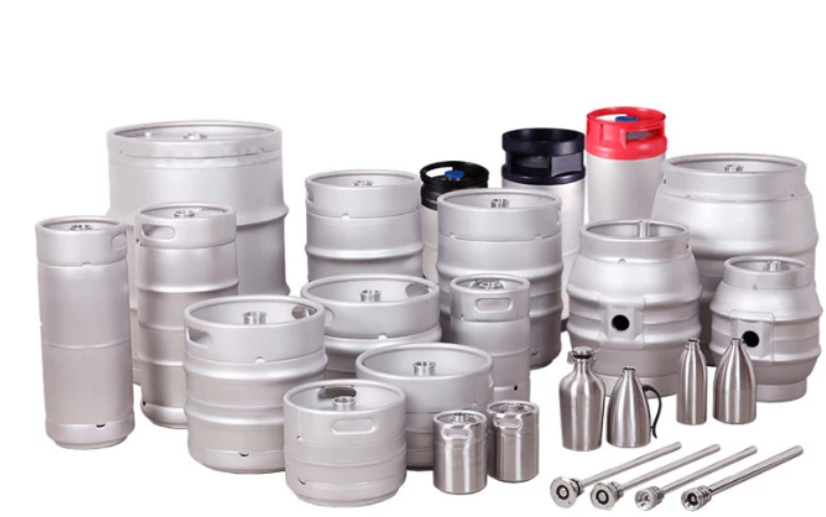
Operating a high-volume taproom, restaurant, or brewery requires precise inventory management and spatial planning. You cannot design an efficient walk-in cooler or configure a multi-tap draft system without knowing the exact dimensions and capacities of the kegs you intend to use. Different beer styles move at different speeds, meaning you need to match your keg sizes to your sales volume to ensure the product remains fresh. This guide details the standard commercial keg sizes used across the United States.
What are the standard commercial keg sizes?
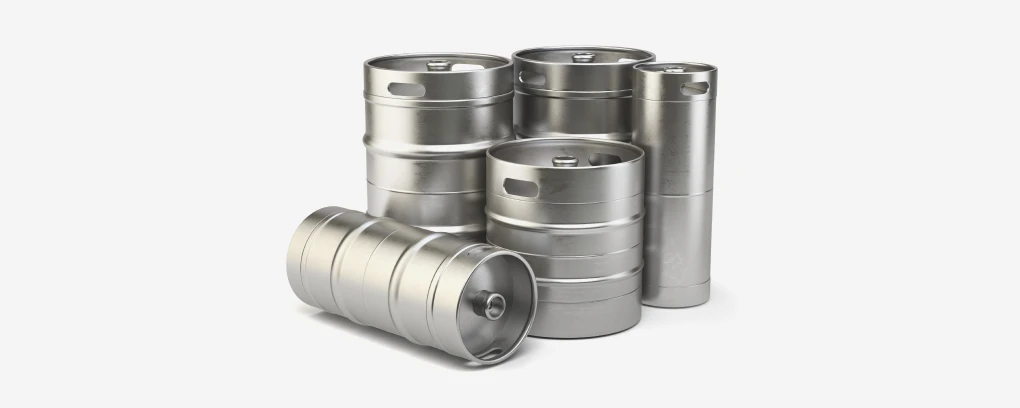
A commercial beer keg is a pressurized metal container, usually made of 304-grade stainless steel, designed to store and dispense liquids under pressure. In the United States commercial beer industry, the standard full-size unit is the half-barrel keg, which holds exactly 15.5 gallons of liquid. Other standard sizes utilized by bars and breweries include the quarter-barrel (7.75 gallons) and the sixth-barrel (5.16 gallons). Understanding these specific capacities allows venue operators to calculate exact pour costs and design accurate cooler schematics.
1/2 Barrel Keg (The Full-Size Standard)
When industry professionals refer to a standard "keg," they mean the 1/2 barrel. This is the backbone of the hospitality industry and fits inside any standard commercial kegerator.
Capacity: It holds 15.5 gallons, which equates to 1,984 ounces.
Yield: You can expect to pour roughly 165 twelve-ounce servings or 124 sixteen-ounce pints from a single half-barrel.
Dimensions & Weight: A standard 1/2 barrel measures 16 1/8 inches in diameter and stands 23 3/8 inches tall. When completely empty, the stainless steel shell weighs about 30 pounds. Once filled with beer, it weighs approximately 160 pounds.
Best Application: High-volume domestic lagers, flagship craft IPAs, and large-scale event venues.
1/4 Barrel Keg (Pony and Slim Quarters)
The quarter-barrel holds exactly half the volume of the standard 1/2 barrel. It holds 7.75 gallons of beer (992 ounces), which yields about 82 twelve-ounce servings or 62 sixteen-ounce pints. Manufacturers produce the 1/4 barrel in two distinct physical shapes to solve different storage problems:
Standard Quarter (Pony Keg): This keg features a short and stubby design. It measures 16 1/8 inches wide and 13 7/8 inches tall. Because it shares the exact same diameter as a full 1/2 barrel, they stack very easily inside a walk-in cooler.
Slim Quarter (Tall Quarter): This version holds the identical 7.75-gallon volume but uses a tall, slender profile. It measures 11 1/8 inches wide and 23 3/8 inches tall. The narrow footprint makes it an excellent choice for dual-tap commercial kegerators where floor space is heavily restricted.
1/6 Barrel Keg (The Sixtel)
The sixth-barrel, almost universally called a "sixtel" in the industry, has largely replaced the old 5-gallon kegs for commercial craft beer distribution.
Capacity: A sixtel holds 5.16 gallons (661 ounces).
Yield: This size yields exactly 55 twelve-ounce pours or 41 sixteen-ounce pints.
Dimensions: It measures 9 1/4 inches wide and 23 3/8 inches tall.
Best Application: Sixtels are the absolute standard for small-batch craft beers, rotating seasonal taps, and experimental brews. Because they hold less liquid, the beer turns over faster, preventing the product from going stale on a slow-moving tap line.
Cornelius Keg (Corny Keg)
Originally designed for the soda industry, the Cornelius keg holds exactly 5.0 gallons (640 ounces). Unlike standard commercial kegs that use a central Sankey valve, Corny kegs utilize a removable lid and separate dual-post connections (either ball-lock or pin-lock).
Yield: A Corny keg pours about 53 twelve-ounce drinks.
Best Application: While rarely used by major commercial breweries today, they remain the dominant standard for homebrewers, mobile coffee carts pushing nitro cold brew, and small-scale kombucha producers.
Quick Reference Capacity Matrix
| Keg Type | Gallons | Ounces | 16oz Pints | Empty Weight | Full Weight |
| 1/2 Barrel | 15.5 | 1,984 | 124 | ~30 lbs | ~160 lbs |
| 1/4 Barrel | 7.75 | 992 | 62 | ~22 lbs | ~87 lbs |
| 1/6 Barrel | 5.16 | 661 | 41 | ~14 lbs | ~58 lbs |
| Cornelius | 5.0 | 640 | 40 | ~10 lbs | ~50 lbs |
Upgrade Your Keg Management Hardware
We manufacture and supply heavy-duty commercial draft equipment built to handle the physical demands of high-volume hospitality venues. From 304-grade stainless steel keg couplers (D, S, U, and A systems) to precision gas regulators, our components ensure a leak-proof connection from the keg valve to your draft line. Contact our supply team today for wholesale pricing on commercial kegerators and keg management hardware.
Frequently Asked Questions
How many standard kegs fit on a commercial pallet?
A standard 48" x 40" shipping pallet holds exactly 8 standard half-barrel (1/2 BBL) kegs on a single tier.
What type of valve is on a standard commercial keg?
The vast majority of commercial beer kegs in the United States use a D-System Sankey valve. European imports frequently use an S-System valve, which requires a matching S-System coupler to tap.
Are aluminum kegs better than stainless steel?
No. The commercial industry overwhelmingly prefers 304-grade stainless steel. Stainless steel withstands harsh caustic cleaning chemicals better than aluminum, resists denting during transit, and prevents metallic off-flavors from leaching into the beer.
-

Written by
Frank WangFrank Wang is a technical content writer focused on industrial manufacturing and equipment applications. He works closely with engineers and project teams to translate real operating conditions, system logic, and product selection considerations into clear, practical content for B2B buyers, project managers, and technical decision-makers.